The Zoetrope of Logic: Why Programs Live in Frozen Time
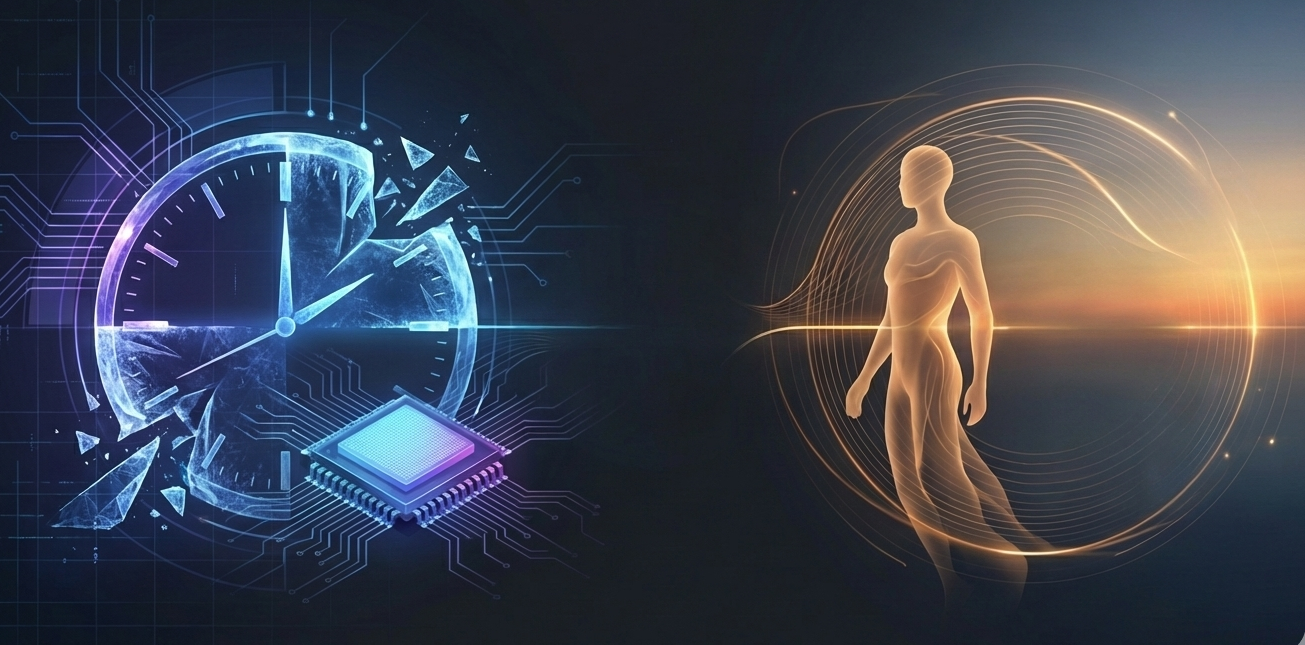
Why Computation Can Simulate the Past, but Never Generate the Living Present
The Illusion of Time in Software
When you watch a video game character run across a screen, witness a real-time stock ticker update, or see a physics simulation unfold, you're experiencing what appears to be continuous, flowing time. But this is a carefully orchestrated illusion. At its foundation, computation has no concept of time whatsoever.
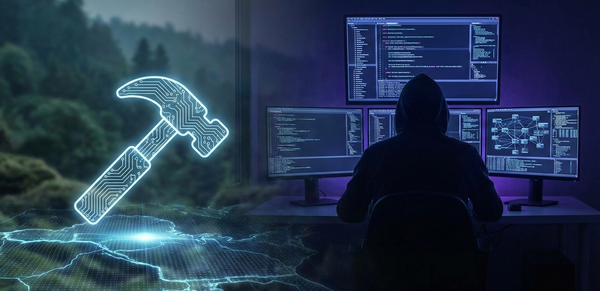
This isn't a limitation of our current programming languages or paradigms—it's a fundamental characteristic of the computational hammer itself. And like all the constraints explored in "The Ultimate Hammer," it shapes what we can imagine building.
The Atemporality of Pure Functions
Consider a simple mathematical function:
f(x) = x²This function doesn't "happen" in time. It doesn't take longer to compute for larger values of x (mathematically speaking). It doesn't have a "before" or "after." It simply is—a timeless relationship between domain and codomain.
The same holds for function composition:
h(x) = g(f(x))This composition exists as a pure mathematical relationship. There's no inherent sequencing, no duration, no temporal flow. The parentheses suggest an order of evaluation, yes, but that's a concession to our computational reality, not a property of the mathematical object itself.
This atemporality is the essential nature of our primary expressive tool. When we write code, we're composing these timeless transformations, and yet we expect them to model dynamic, temporal systems.
Where Time Enters: The Three External Impositions
Since our fundamental building blocks lack temporal properties, time must be injected into computation from the outside through three distinct mechanisms:
1. Big O Complexity: The Cost of Transformation
Big O notation tells us how the cost of a computation scales with input size. An O(n²) algorithm requires roughly n² operations for an input of size n. But note: this still isn't time. It's a count of abstract operations, a measure of computational work.
Big O lives in a platonic realm where operations are compared relative to each other, but where no clock ticks.
2. Clock Speed: The Hardware Tempo
Hardware introduces actual duration. A 3 GHz processor completes roughly 3 billion cycles per second. When combined with Big O complexity, this gives us execution velocity—the rate at which our atemporal transformations manifest in physical reality.
But this execution velocity remains external to the logic we're expressing. A sorting algorithm doesn't "know" whether it's running on a smartphone or a supercomputer. The temporal characteristics of its execution belong to the substrate, not the substance.
3. Delta Time (Δt): The Imposed Clock
To create the appearance of continuous time in software, we introduce Δt—a discrete time step that samples our atemporal logic at regular intervals.
This is the technique behind every game loop, every animation system, every real-time simulation:
function gameLoop(dt) {
  updatePhysics(dt);
  updateAnimation(dt);
  render();
  requestAnimationFrame(gameLoop);
}
Each function receives dt as a parameter—typically something like 16.67ms (for 60 FPS). This value is imposed from outside the logic itself, creating a synchronized temporal framework within which all subsystems operate.
The Architecture of Temporal Illusion
We can visualize the relationship between these concepts:
| Concept | Nature | Role |
|---|---|---|
| Function | Atemporal | Defines what happens (the transformation) |
| Big O | External | Defines the cost of the transformation |
| Clock Speed | Hardware | Defines how quickly operations complete |
| Δt (Delta Time) | Imposed | Defines when transformations appear to occur |
Notice the progression: we start with completely timeless logic, then layer on increasingly concrete temporal constraints until we arrive at something that appears to unfold in time.
The Fundamental Compromise
Here's the uncomfortable truth: the "time" we experience in software is an illusion created by sampling atemporal logic at specific intervals.
Consider a physics simulation calculating an object's position:
function updatePosition(object, dt) {
  object.position += object.velocity * dt;
  object.velocity += object.acceleration * dt;
}
This function is still fundamentally atemporal. It defines a transformation: given a current state and a time delta, produce a new state. The fact that we call this function 60 times per second doesn't make the function itself temporal—it makes our invocation temporal.
The actual temporal phenomenon—the object moving through space—exists only in the aggregate pattern of discrete snapshots, like frames in a film creating the illusion of continuous motion.
What Gets Lost in Translation
This temporal gap has profound implications for what we can easily express in software:
The Concept of Continuous Processes Become Discrete Approximations
Within the concept that we have of the physical world, an object falling under gravity follows a continuous trajectory. In software, we approximate this with discrete position updates. The smaller the Δt, the better the approximation—but it remains an approximation, a sampling of the concept of a continuous process we can never directly express.
The Concept of Time Becomes Uniform
By imposing a single Δt across a system, we force all processes to march to the same drummer. But real systems often have multiple temporal scales:
- Millisecond-level: user input processing
- Second-level: AI decision-making
- Minute-level: resource regeneration
- Hour-level: day/night cycles
To handle these, we either subdivide our Δt (inefficient) or introduce separate timing systems (complex). Either way, we're fighting against the atemporal nature of our tools.
"Lived Time" Cannot Be Directly Expressed
Within our conception of the real world, an entity has its own temporal experience. A plant grows at a different rate than an animal ages. An excited person experiences time differently than a bored person. These are intrinsic temporal properties.
In computation, all temporal properties are extrinsic. We must express these diverse times by maintaining time-scaling factors, explicitly tracking durations, and carefully synchronizing across different temporal frames of reference.
The Deeper Pattern
This temporal gap is another instance of the fundamental theme from "The Ultimate Hammer": our computational tools force us to decompose continuous, integrated phenomena into discrete, separated components.
We must conceptually separate the what of our logic from the when of its execution.
The hammer of computation is atemporal. To express anything that moves, changes, or evolves, we must impose time from the outside, creating an elaborate scaffolding of clocks, deltas, and synchronization mechanisms that have no counterpart in the logic we're trying to express.
Living with the Gap
I'm not arguing we should abandon computation. Rather, understanding this temporal gap helps us recognize:
- Why real-time systems are hard: We're approximating continuous time with discrete samples, and the impedance mismatch shows up as bugs, jitter, and synchronization issues.
- Why temporal reasoning is separate: Time-based logic (debouncing, throttling, scheduling) requires special treatment because time isn't a first-class concept in our expressions.
- Why we need frameworks: Game engines, reactive systems, and real-time frameworks exist partly to paper over this gap—to provide temporal abstractions on top of atemporal foundations.
- Why some problems feel unnatural: Systems with intrinsic temporal properties resist computational modeling because we must externalize the concept of time.
A Thought Experiment
Imagine a conceptual framework where temporal relationships were first-class citizens. Where you could express "this happens continuously at this rate" as directly as you currently express "this happened." This is, and much more, what applied Geneosophy allows you to express.
Closing Thought
The next time you watch a smooth animation, consider: you're not seeing computation happening in time. You're seeing atemporal transformations being sampled by an external clock, their results flickering into existence like frames in a zoetrope—discrete snapshots creating the illusion of continuous motion.
The program itself exists in a timeless present, a frozen garden of pure relationships. It's only when we breathe life into it with Δt that it begins to dance.
And that dance—beautiful and useful as it is—is always an approximation of the concept of time that we're trying to capture.